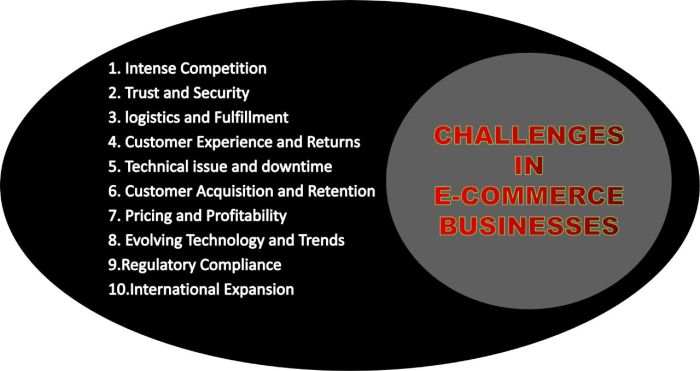
Navigating the complex world of e-commerce can be challenging, with numerous obstacles hindering growth and profitability. This guide tackles seven common e-commerce problems, providing actionable strategies to overcome them and boost your online business’s success. We’ll explore solutions to issues ranging from high cart abandonment rates to low customer acquisition costs and poor website performance, equipping you with the knowledge to optimize your operations and drive sustainable growth.
From optimizing your checkout process to implementing effective marketing strategies and enhancing your website’s user experience, we’ll delve into practical techniques and best practices to improve key performance indicators. The information presented is designed to be readily applicable, offering a clear path to resolving these frequently encountered challenges and building a thriving online presence.
High Cart Abandonment Rates

High cart abandonment rates represent a significant challenge for e-commerce businesses. A substantial portion of potential sales is lost when customers add items to their carts but fail to complete the purchase. Understanding the underlying causes and implementing effective strategies to recover these lost sales is crucial for profitability.
High cart abandonment is a multifaceted problem stemming from various factors. Unexpected costs, such as shipping fees or taxes added at checkout, often deter customers. A complicated or lengthy checkout process, requiring excessive registration or form filling, can also frustrate potential buyers and lead them to abandon their carts. Security concerns, particularly regarding the security of credit card information, are another major contributor. Finally, a lack of sufficient payment options can limit a customer’s ability to complete their purchase.
Checkout Optimization Strategies
Optimizing the checkout process is paramount in reducing cart abandonment. Streamlining the process, minimizing the number of steps, and making it clear and intuitive can significantly improve conversion rates. One effective strategy is offering guest checkout, allowing customers to purchase without creating an account. This eliminates a potential friction point and speeds up the process. Another key element is clearly displaying all costs upfront, including shipping, taxes, and any other fees, to avoid surprises at the final stage. Implementing a progress bar that visually shows the customer’s progress through the checkout process can also help to maintain engagement and encourage completion. Furthermore, incorporating a secure checkout system that displays trust badges and uses encryption to protect customer data is crucial to build confidence and reduce security concerns.
Effective Abandoned Cart Email Campaigns
Email marketing plays a vital role in recovering abandoned carts. A well-designed email sequence can remind customers of their abandoned items and encourage them to complete their purchase. The first email, sent a few hours after cart abandonment, should be a gentle reminder, highlighting the items left in the cart and providing a direct link back to the checkout page. Subsequent emails can offer a small discount or incentive to complete the purchase, creating a sense of urgency. Personalized emails that address the customer by name and reference the specific items in their abandoned cart are more effective than generic messages. The email design should be visually appealing and mobile-friendly, ensuring a seamless experience across devices. For example, an email could say, “Hi [Customer Name], we noticed you left some amazing items in your cart! Click here to complete your purchase and receive 10% off your order.”
Comparison of Cart Recovery Strategies
| Strategy | Implementation | Cost | Effectiveness |
|---|---|---|---|
| Abandoned Cart Email Sequence | Automated email series triggered by cart abandonment. | Low (email marketing platform costs) | High (recovery rates can reach 20-30%) |
| Discount Offer | Offering a percentage discount or free shipping on abandoned cart items. | Medium (depends on discount percentage) | Medium to High (can significantly boost recovery rates) |
| Personalized Retargeting Ads | Displaying ads featuring abandoned cart items on social media or other websites. | Medium to High (depends on ad spend and targeting) | Medium (effective for reaching customers who abandoned carts and are browsing online) |
| Live Chat Support | Offering real-time assistance to answer questions and address concerns during checkout. | High (requires dedicated customer support staff) | High (can resolve issues and prevent abandonment in real-time) |
Low Customer Acquisition Cost (CAC)

Lowering your customer acquisition cost (CAC) is crucial for the long-term health of any e-commerce business. High CAC eats into profits, limiting growth potential and hindering scalability. This section explores effective strategies to acquire new customers cost-effectively, examining various channels and outlining a sample marketing plan for optimized budget allocation.
Effective strategies for acquiring new customers at a lower cost often involve a multi-pronged approach, focusing on organic reach and highly targeted paid campaigns. Understanding the nuances of each channel is key to maximizing ROI and minimizing wasted spending. This requires careful analysis of your target audience, their online behavior, and the platforms they frequent most.
Customer Acquisition Channel Analysis
Different customer acquisition channels offer unique advantages and disadvantages. A balanced approach is often the most effective.
- Social Media Marketing: Organic social media strategies, focusing on engaging content and community building, can yield high returns with minimal upfront cost. However, organic reach can be limited, requiring consistent effort and potentially paid boosts for wider visibility. Paid social media advertising allows for highly targeted campaigns, reaching specific demographics and interests. The downside is the ongoing cost of advertising and the need for constant A/B testing to optimize campaigns.
- Paid Advertising (PPC): Pay-per-click (PPC) advertising, such as Google Ads or other search engine marketing, allows for immediate visibility to potential customers actively searching for products or services like yours. While effective, PPC can be expensive, requiring careful research and campaign optimization to maximize ROI. Poorly managed PPC campaigns can quickly drain budgets without generating sufficient returns.
- Content Marketing: Creating high-quality, valuable content (blog posts, articles, videos, infographics) attracts organic traffic through search engines and social media. This strategy builds brand authority and trust, fostering long-term customer relationships. The drawback is that content marketing requires significant time and effort to produce results, and the impact may not be immediately apparent.
- Email Marketing: Email marketing remains a powerful tool for nurturing leads and converting them into paying customers. Targeted email campaigns can be highly effective at driving sales and promoting loyalty. However, maintaining a clean and engaged email list is essential, and email deliverability can be challenging if not managed properly.
Sample Marketing Plan for Minimizing CAC
This plan Artikels a balanced approach, allocating budget across multiple channels to minimize CAC while maximizing ROI. Remember that this is a sample plan; the optimal allocation will depend on your specific business and target audience.
- Goal: Reduce CAC by 15% within six months.
- Budget Allocation:
- Content Marketing: 30% – Focus on creating high-quality blog posts, optimization, and guest blogging to attract organic traffic.
- Social Media Marketing: 30% – Implement a mix of organic posting and targeted paid advertising on platforms like Facebook and Instagram.
- Paid Advertising (PPC): 25% – Run targeted Google Ads campaigns focusing on high-conversion s.
- Email Marketing: 15% – Develop automated email sequences for nurturing leads and promoting repeat purchases.
- Specific Tactics:
- Content Marketing: research, optimization, guest blogging on relevant websites, creation of valuable and shareable content.
- Social Media Marketing: Engaging content creation, community management, targeted advertising campaigns with A/B testing, influencer marketing.
- Paid Advertising (PPC): research, ad copy optimization, negative targeting, conversion tracking, regular campaign monitoring and adjustments.
- Email Marketing: List building through website forms and lead magnets, automated email sequences, personalized email campaigns, email deliverability optimization.
- Monitoring and Adjustment: Regularly track key metrics such as CAC, customer lifetime value (CLTV), conversion rates, and ROI for each channel. Adjust the budget allocation and strategies based on performance data.
Poor Website Performance and User Experience
A slow, clunky, or confusing website is a major obstacle to e-commerce success. Poor website performance and a negative user experience directly translate to lost sales and frustrated customers. Addressing these issues is crucial for boosting conversions and building a loyal customer base. This section will explore common website problems, the importance of speed and mobile responsiveness, and practical steps to improve your online store’s performance.
Website speed and user experience are intrinsically linked. A slow-loading website leads to high bounce rates, abandoned shopping carts, and ultimately, lost revenue. Mobile responsiveness is equally crucial, given the increasing number of shoppers browsing and purchasing on their smartphones and tablets. A website that isn’t optimized for mobile devices will likely result in a poor user experience and lost sales opportunities. The following section will demonstrate how to diagnose and address these issues.
Website Performance Issues and Their Impact
Slow loading times, poor navigation, and a confusing layout are common website issues that negatively impact the user experience. Slow loading times, in particular, can lead to high bounce rates, as users are less likely to wait for a page to load. Poor navigation makes it difficult for users to find what they are looking for, while a confusing layout can be overwhelming and frustrating. These issues collectively contribute to a negative user experience, driving customers away and impacting sales. The impact of these issues is significant, potentially leading to substantial losses in revenue and brand reputation.
Improving Website Performance and User Experience
Optimizing website performance and enhancing user experience involves a multi-faceted approach. This includes optimizing images, leveraging browser caching, minimizing HTTP requests, and using a content delivery network (CDN). Mobile responsiveness requires a responsive design that adapts to different screen sizes and devices. Clear and intuitive navigation, a well-structured layout, and a user-friendly interface are also essential. These improvements collectively enhance the overall shopping experience, leading to increased conversions and customer satisfaction.
Examples of Website Improvements
The following table illustrates before-and-after examples of website improvements, showcasing the positive impact on user experience and conversion rates.
| Problem Area | Before Improvement | After Improvement | Results |
|---|---|---|---|
| Page Load Time | Average load time of 8 seconds; high bounce rate (45%). Images were large and unoptimized. Navigation was complex and confusing. | Optimized images, implemented caching, and used a CDN. Average load time reduced to under 2 seconds. Simplified navigation with clear calls to action. | Bounce rate decreased to 15%; conversion rate increased by 20%. |
| Mobile Responsiveness | Website was not optimized for mobile devices; difficult to navigate and view products on smaller screens. | Implemented a responsive design; website adapts seamlessly to different screen sizes. | Mobile traffic increased by 30%; mobile conversion rate improved by 25%. |
| Website Navigation | Complex menu structure; users struggled to find specific products or categories. | Simplified navigation menu; implemented a clear search bar and product filtering options. | Improved user engagement; reduced bounce rate by 10%. |
| Product Page Design | Product images were small and low-resolution; product descriptions were lacking key information. | High-quality product images; detailed and informative product descriptions, including customer reviews. | Increased average order value by 15%; higher customer satisfaction. |
Wrap-Up

By addressing these seven common e-commerce problems – high cart abandonment, low customer acquisition cost, and poor website performance – you can significantly improve your online store’s efficiency and profitability. Implementing the strategies Artikeld, from refining your checkout experience to optimizing your marketing efforts and enhancing website usability, will pave the way for a more successful and sustainable e-commerce venture. Remember, continuous monitoring and adaptation are key to long-term success in the dynamic landscape of online retail.